


How to Beach in Tuscany (A Guide from Lucca)
Updated: Aug 10
With spring in the air, our thoughts are drifting to summer days at the beach. One thing that often surprises people visiting Lucca is just how easy it is to reach the coast. In only 20 minutes by train (plus a 10ish minute walk from the station to the beach), you can go from the medieval walls and cobblestone streets to wide sandy beaches along the Tuscan coast. It is one of the many reasons we fell in love with Lucca.

Going to the beach in Italy is a little different from what you may be used to. If you're used to packing a cooler, carrying chairs across the sand, and setting up your own spot for the day, the Italian beach experience will feel very different. You may actually find it a bit disappointing if you are trying to recreate that classic American-style beach day.
How Beach Culture Differs from the United States
For many visitors from the United States, the biggest difference is the level of structure.
In the U.S., beaches are typically wide open spaces where people bring their own chairs, umbrellas, coolers, and toys to set up for the day.
In Italy, especially along the Tuscan coast, beach days are generally more organized and service-oriented. Instead of setting up yourself, you reserve a designated spot at a beach club, where umbrellas and lounge chairs are already arranged in neat rows. Most clubs also offer amenities like changing cabins, showers, and on-site cafés or restaurants serving everything from espresso to fresh seafood and spritzes. You can arrive with very little, settle in, and ease into a slower rhythm.

The Italian Beach Club Experience
Much of Italy’s coastline is divided into private beach clubs, known as lidi, bagni, or stabilimenti balneari. Rather than hauling your own gear, you reserve a setup (typically two lounge chairs and an umbrella) for the day or even the entire season. Many Italian families buy memberships and return to the same club year after year, making it a central part of summer life.
Once you check in, that space becomes your home base. Most clubs include access to bathrooms, changing rooms, and showers, while some offer extras like pools, beachside bars, or full-service restaurants. Options range from simple, family-friendly spots to more upscale clubs with padded loungers, cabanas, or towel service.
These aren’t resorts, but they often provide a similar level of comfort and convenience. Their orderly, closely spaced rows are designed to maximize limited beachfront space. Even so, spending a day at a beach club remains one of the most quintessential and enjoyable ways to experience the Italian coast.

How Do You Know Which Beach Club to Reserve?
There are more than 100 beach clubs in Viareggio alone! So, how are you supposed to pick?
When choosing a beach club in Italy, it helps to start by narrowing down your priorities, whether that is location, vibe, or amenities. Some people want a relaxed, family-friendly spot, while others look for a more upscale or lively atmosphere with music and a restaurant. A good first step is to search your destination along with terms like “lido” or “stabilimento balneare,” then browse options on sites like Spiagge.it or platforms such as TripAdvisor.
Reviews are also important, since they often highlight things you can't see in photos...like how crowded it gets, service quality, or whether the experience feels worth the price. Even some highly rated clubs are praised for food and service but as more expensive than others nearby, which can help set expectations. If you are visiting in peak season, it is also smart to check availability in advance or ask your local host for recommendations.
Beach club prices vary depending on location, time of year, and how close you want to be to the water.
In the Lucca area, expect something roughly like this during summer:
Around €25 to €40 for a basic umbrella and two chairs farther back from the water
Around €40 to €80 for spots closer to the sea, with higher prices for front row loungers, cabanas, or premium clubs. Depending on the area, it can be significantly higher (Forte dei Marmi, for example).
Food and drinks are extra
Many clubs don’t publish full pricing online. Calling ahead or emailing to ask about rates is best.
Prices often spike around Ferragosto (mid‑August), when everyone is escaping the city.
Some clubs offer half‑day rates or discounts for multi‑day stays.
Do not expect to show up without a reservation and get a spot during peak season. Weekends in July and August are the busiest, so making a reservation is highly recommended, especially if you want a spot closer to the water. If you are visiting outside peak season or arriving early in the morning, you can sometimes walk up and choose your spot for the day, but don't count on it.
Some clubs include parking or offer it at a nominal fee.
Some beach clubs accept reservations by email or through their websites. Using Google Translate can be very helpful if you want to send a quick message in Italian. Even a short translated request is usually appreciated.


This is where the Italian beach experience really stands apart.
Lunch at the beach is often a full meal at a seaside restaurant. It is very common to sit down for a leisurely lunch that stretches to an hour or two...think grilled fish, pasta with seafood, a bottle of chilled white wine, and views of the sea.
In Italy, there’s a traditional belief that you should rest for a bit after eating before swimming, so many people return to their chairs or go for a gentle stroll, or an afternoon nap under the umbrella. It is less about rushing and more about settling in, savoring the food, and enjoying the day.
Free Beaches (Spiaggia Libera)
While beach clubs dominate, not every beach in Italy requires renting chairs. There are also “spiaggia libera,” or free beaches, where anyone can lay down a towel and enjoy the day. You will not have reserved chairs, showers, or restaurants directly attached to the beach, though there are often cafés nearby.
In Viareggio, the largest spiaggia libera sits near the harbor and the southern end of town.
The glamorous resort town of Forte dei Marmi is famous for its elegant beach clubs, but it still maintains small spiagge libere so everyone can access the beach. These sections are typically found at the edges of town or between private clubs.
If you opt to experience the free beaches, you can break up your day with a stroll on the promenade, grab a pizza and do some shopping. It can be a relaxed way to enjoy the coast without the structure and added expense of a beach club.
Keep in Mind:
Space is limited because beach clubs dominate most of the coastline.
Arrive early to claim your spot.
You still get beautiful views of the Apuan Alps behind the beach.
Best Beaches Near Lucca
The Tuscan coast is not the dramatic scenery you might find in Sardinia or Puglia. The beaches are long and wide with golden-sand. Unlike beaches along the Amalfi Coast, the seabed is sandy rather than rocky. One of the reasons we love Lucca is that several very different beach towns are within easy reach.
Viareggio
Distance from Lucca: about 20 to 30 minutes
Best way to get there: train or car
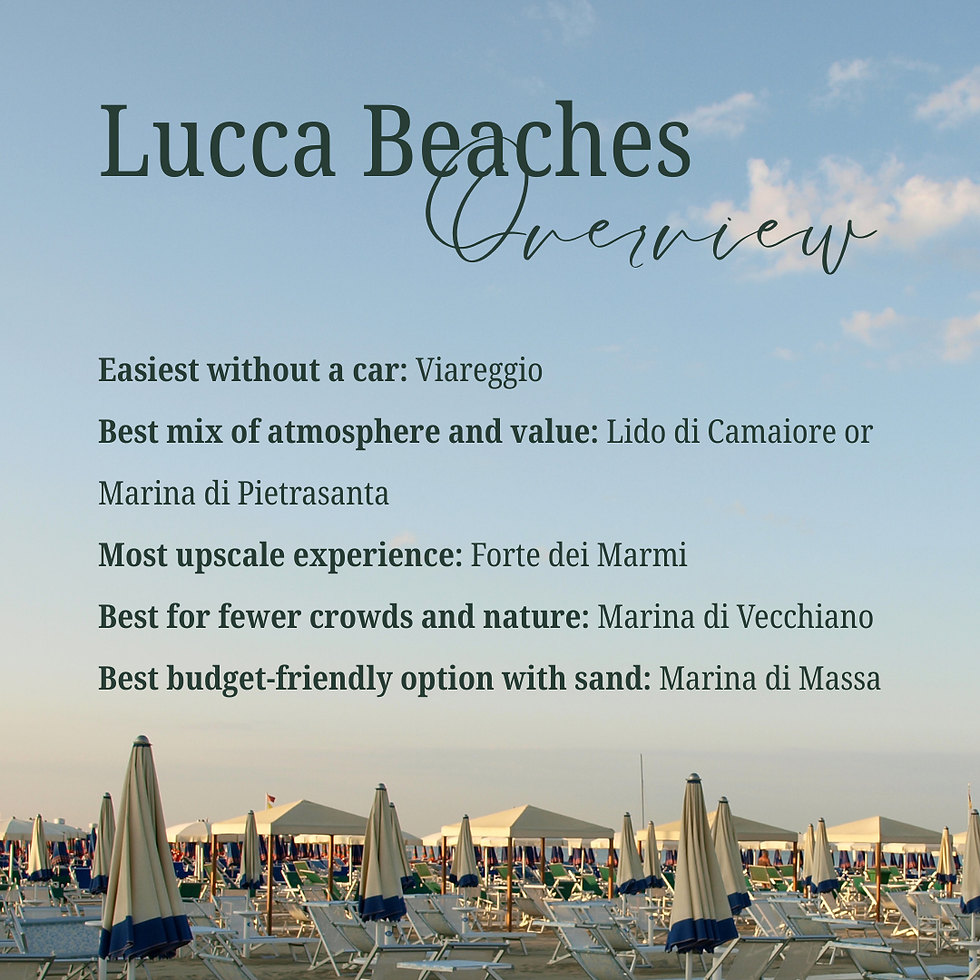
Viareggio is the closest and easiest beach trip from Lucca. Trains run frequently and take about 20 minutes, making this the most convenient option without a car. It has a long, wide sandy beach and a lively promenade lined with cafés, shops, and restaurants. It feels like a classic Italian seaside town.
The beach is organized into many beach clubs with rows of umbrellas. The water is calm and the sand is soft, which makes it a strong choice for families.
Free beaches or beach clubs:
Mostly beach clubs, with some free sections
Average cost: €25 to €50 per day
Good for a full beach day with lunch, gelato, and an evening stroll before heading back to Lucca.

Forte dei Marmi
Distance from Lucca: about 35 to 40 minutes
Best way to get there: car or taxi
Forte dei Marmi is more upscale and known for elegant beach clubs and a stylish crowd. Many clubs offer restaurants, private cabanas, and full service. It is especially popular with visitors from Milan and Florence.
The town itself has high-end boutiques and a relaxed but polished atmosphere.
Free beaches or beach clubs:
Mostly private beach clubs
Very limited free beach
Average cost: €50 to €150 or more per day
Best for a more refined or special beach day.
Marina di Pietrasanta
Distance from Lucca: about 30 to 40 minutes
Best way to get there: car
Just south of Forte dei Marmi, Marina di Pietrasanta offers a quieter and slightly more relaxed atmosphere. The beaches are sandy and well maintained, with a good mix of beach clubs and restaurants.
It strikes a nice balance between style and a more low-key feel. The nearby town of Pietrasanta is also worth visiting for art and galleries.
Free beaches or beach clubs:
Mostly beach clubs with some free areas
Average cost: €25 to €60 per day

Lido di Camaiore
Distance from Lucca: about 30 to 40 minutes
Best way to get there: car
Lido di Camaiore is an easy and often more affordable option. The beach is wide and sandy, and there is a long pier extending into the sea.
It has plenty of beach clubs and restaurants and tends to attract families and locals looking for a relaxed day.
Free beaches or beach clubs:
Mix of beach clubs and some free areas
Average cost: €20 to €40 per day
Lido di Camaiore is one of our favorite beaches. If you don't have a car, you can take the train from Lucca to Viareggio (about 20‑30 min), then a taxi from Viareggio to Lido di Camaiore, typically around 5 minutes on the road. A metered taxi ride for this short trip usually costs around €8‑€14 depending on traffic, time of day, and whether you hail or pre‑book the cab.
If you’d prefer an even cheaper option, local buses also run between Viareggio and Lido di Camaiore for only a couple of euros and take around 9 minutes. One final option is to take the train and then stroll (maybe 15-25 minutes) the promenade that stretches from Viareggio to Lido di Camaiore, which is a pleasant walk if it's not too hot. You'll see lots of beach clubs, restaurants and shopping along the way.
Marina di Massa
Distance from Lucca: about 40 to 45 minutes
Best way to get there: car
Marina di Massa feels more local and less touristy. It is a good option if you want something simpler and more budget-friendly while still having sandy beaches.
Free beaches or beach clubs:
More free beach areas than other Versilia towns
Average cost: €20 to €40 per day
Marina di Pisa
Distance from Lucca: about 45 minutes
Best way to get there: car
Marina di Pisa has a quieter, more natural feel. Some areas are sandy, while others are rockier compared to the Versilia coastline.
Free beaches or beach clubs:
Good number of free areas
Average cost: €15 to €35 per day
Take a boat tour! Daniele will take you on his sailboat - Based in Marina di Pisa, it's the ideal starting point to explore the Tuscan coast, the Tuscan Archipelago, Liguria and numerous anchorages reachable only by sea. Learn more and book here.
Marina di Vecchiano
Distance from Lucca: about 20 to 30 minutes
Best way to get there: car
Marina di Vecchiano is very different from the others. It sits inside a protected natural park with dunes and pine forest, giving it a wild and undeveloped feel.
The beach is wide and sandy, with far fewer crowds and very little commercial development. Best if you want space, nature, and a quieter experience rather than beach clubs.
Free beaches or beach clubs:
Mostly free beach
A few simple establishments
Parking fees may apply
Wear Your Sunscreen!
The Italian sun is surprisingly strong, even on days that feel mild, and UV levels can be higher than many travelers expect. Sunscreen is essential! Italian pharmacies and cosmetic shops offer a wide range of sunscreens that are often more gentle on the skin than many products found in the U.S. Slather it on generously, reapply as needed, and enjoy the sun safely.
A Beach Day From Lucca
When friends and family visit us in Lucca, we usually suggest making a reservation at a beach club and taking the train to Viareggio for an easy beach day. If you're up for a little bit more of an adventure, we recommend Lido di Camaiore.
Rent chairs at a beach club, go for a swim, and then sit down for a long seaside lunch. Afterward, you can walk along the promenade, grab a gelato, and take the train back to Lucca in the evening.

